RULLY PREMIER CRU
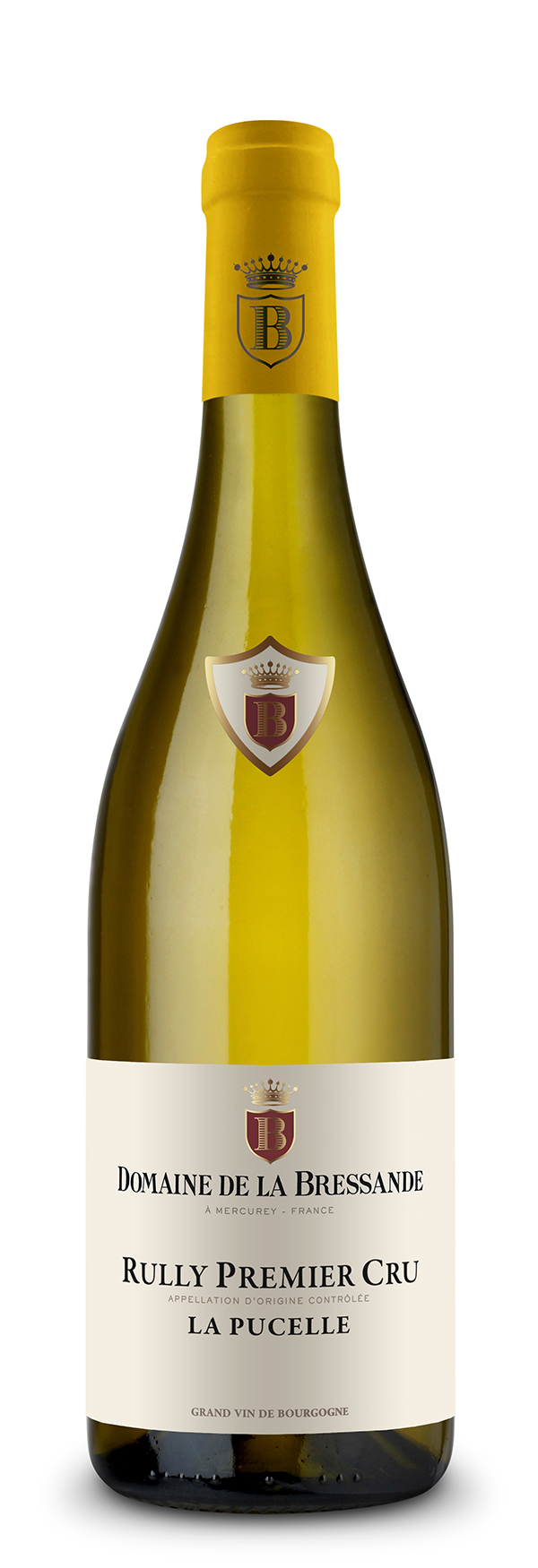
LA PUCELLE 2021
Grape Variety
Chardonnay.
Tasting notes
Colour: pale gold.
Bouquet: a fine citrus-driven bouquet with pleasant toasty notes.
Palate: delicate lemon aromas. A wine defined by finesse and elegance, with a vibrant freshness on the palate.
Food and wine pairing
Ideal with cold starters and hot starters (quiches, hot tarts, etc.), as well as seafood, fine fish, white meats with a light sauce, poultry in sauce and mature cheeses.
Serving suggestions
Ideally served at a temperature of 12° to 14°C. (54-57°F.).
Ageing potential
It will keep for 5 to 7 years in the cellar.
Origin
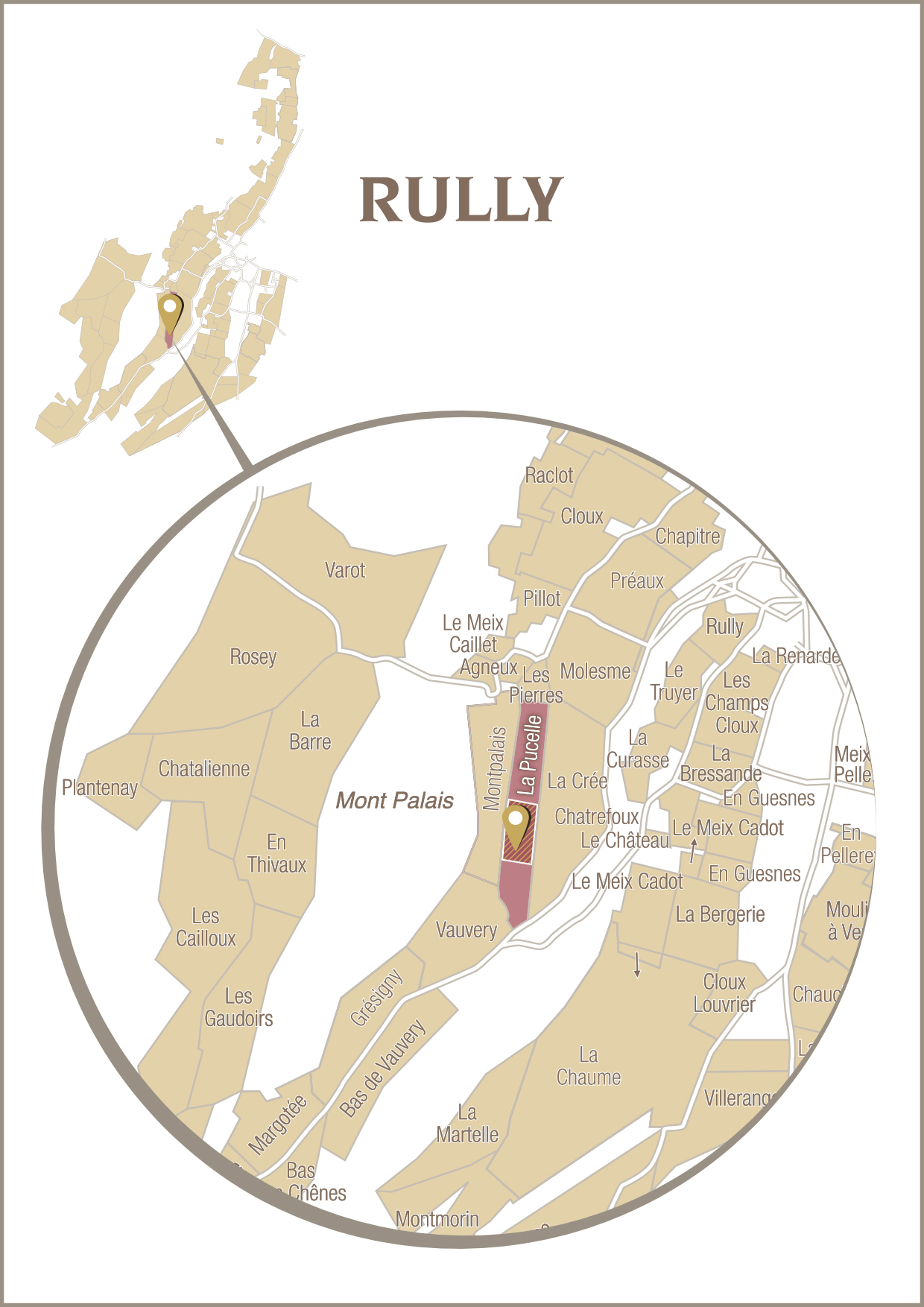
Rully is one of the famous village of the Côte Chalonnaise, in the South of Burgundy. A communal appellation made up of 23 Premiers Crus climats. White Rullys spread on a 261 ha area - including 68 ha of Premiers Crus - whereas red Rullys are produced on a 116 ha area of which 28 are Premiers Crus.
Rully was named after a rich roman, Rubilius, who built a villa and founded the village during the roman occupation. It was at first named Rubiliacum and it evolved through the years to become the current Rully.
Terroir
The Domaine’s Rully Premier Cru La Pucelle covers an area of 1.5 hectares.
The Chardonnay vines are around forty years old and are grown on a terroir of brown limestone soils, very stony, with some clay colluvial deposits.
The origin of the name dates back to the Middle Ages. According to the story, the Lord of Rully divided his lands and gave the finest parcel to his youngest daughter. La Pucelle derives from the Latin adjective “Pulcella,” meaning “pretty,” “beautiful,” or “charming.”
Vinification and maturing
The Chardonnay grapes were hand-harvested on September 27 from our Premier Cru “La Pucelle” parcel. They were carefully sorted and transported in 16 kg crates.
Following pneumatic pressing, the must underwent 16 to 24 hours of cold settling to remove coarse lees (solid particles from skins, stems, and other impurities that settle by sedimentation). Alcoholic fermentation took place in temperature-controlled stainless steel tanks, ensuring precise temperature control and a homogeneous cuvée before transfer to barrel at the end of fermentation.
The wine was then aged for 8 months on fine lees in 228-litre barrels (25% new oak), with occasional bâtonnage (stirring = approximately twice a month) until malolactic fermentation, in order to develop aromatic complexity while preserving fruit purity and protecting the wine by keeping the fine lees in suspension.
Vintage : 2021
Nature certainly set a challenge for the winegrower and the winemaker with this vintage.
It began with very warm temperatures at the end of February which led to an early bud break.
The historic frost in April then destroyed young shoots that had emerged too early, significantly affecting the future harvest. Changing weather continued to characterize the vintage through to the harvests.
There were spells of rain from May to mid-August, obliging winegrowers to be constantly on the alert. The only periods of relative calm were during flowering, which took place in good conditions for the formation of the future fruit, and the véraison (colour change), which benefited from the return of the sun from mid-August.
The vagaries of the weather contributed to the development of outbreaks of disease, which were contained thanks to the tireless efforts of our winegrowers. In spite of this, considerable sacrifices had to be made to ensure a high level of quality, and rigorous sorting of the fruit in the vineyard and on arrival at the winery was necessary.
This vintage also required a major technical effort. The vinifications had to be carried out with meticulous attention and precision with a particular care over the extraction of colouring matter, the balance of the structure and the aromatic expression of the red wines, and of the freshness, balance of acidity and aromatic potential of the white wines.