RULLY 2024
Grape Variety
Chardonnay.
Tasting notes
Colour: Beautiful golden yellow.
Nose: A rather floral expression on this vintage, the notes of honeysuckle dominate and are followed by a woody touch, present and well integrated into the wine texture.
Palate: Here is a great white Burgundy, fruity with a nice balance and a good persistence.
Food and wine pairing
This wine will be perfect paired with charcuterie platters (ham or pâtés) or sea food (scallop-shells, salmon). It can also be drunk with hot first courses, such as quiches and pies, or with dry cheeses (goat’s cheese for instance).
Serving suggestions
Serve ideally between 12° and 14° C / 54° and 57°F.
Ageing potential
4 to 5 years after the vintage, or even more in good cellaring conditions.
Origin
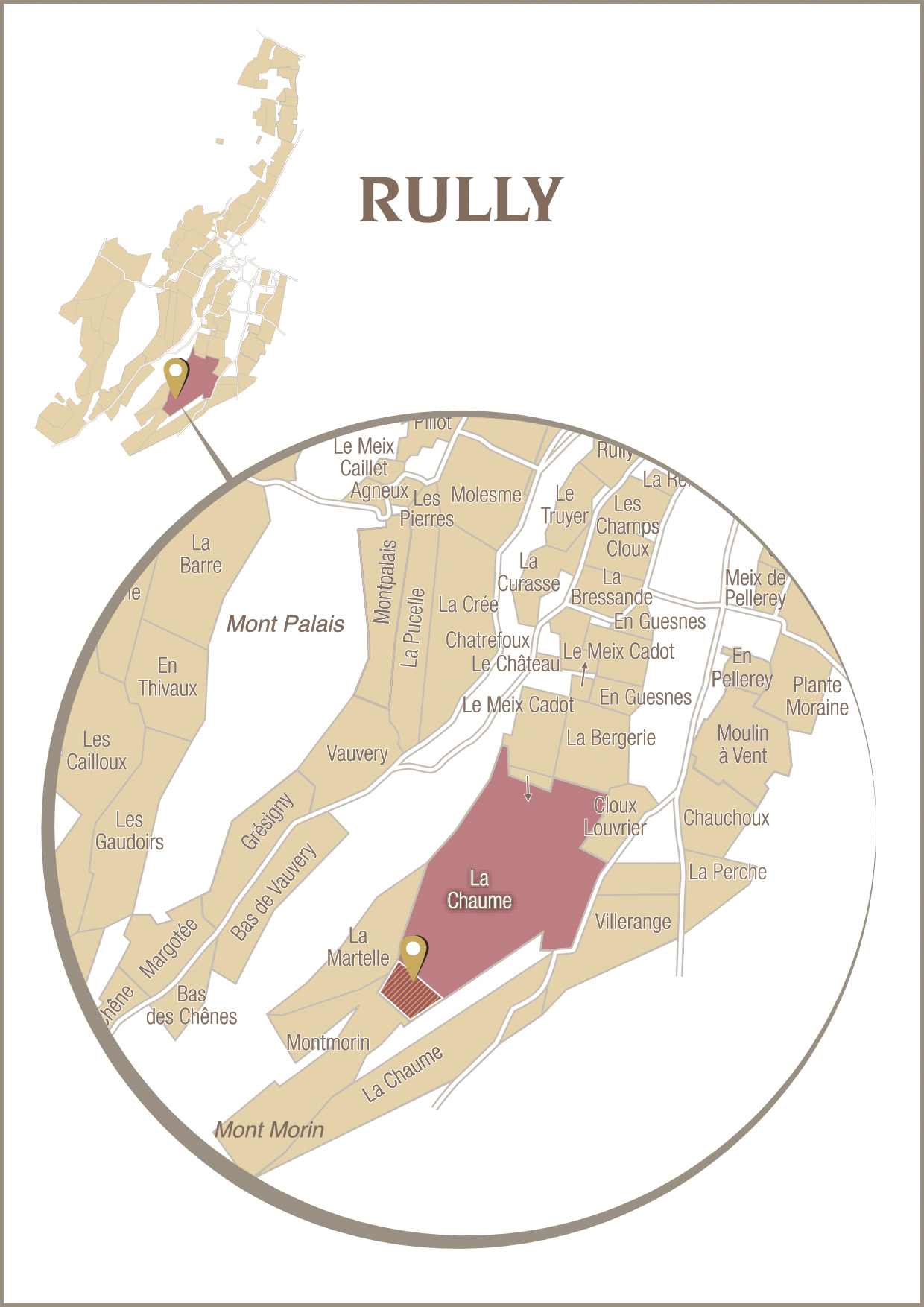
Rully is a communal appellation of the Côte Chalonnaise, in the South of Burgundy, made up of 23 Premiers Crus climats.
White Rullys spread on a 246 ha area - including 69 ha of Premiers Crus - whereas red Rullys are produced on a 121 ha area of which 28 are Premiers Crus.
Domaine de la Bressande currently cultivates 21.35 hectares in the Rully Village and Rully Premier Cru appellations.
Three plots, forming a total of 2.6 hectares, are the source of the Domaine’s Rully Village white wine.
Terroir
- Vineyard area: 2,6 ha (4.95 acres)
- Average vines age: 30 years
- Soil: Clay-limestone
Vinification and maturing
The Chardonnay grapes were sorted carefully at their arrival in the winery before being pressed in a pneumatic press to squeeze out their juice.
This juice was left to settle at cold temperatures between 16 and 24 hours maximum in order to remove impurities. The alcoholic fermentation took place in vats to allow for a better control of temperatures, key element in our search for pure color and bright aromas.
Then, just before the fermentation ended, the wine was put into oak barrels (including 20% new barrels) on fine lees for 9 months,
with occasional stirring (about twice a month) until the malolactic fermentation, in order to develop both complex aromas and preserve the purity of the fruit, and also to protect the wine (from oxidation and reduction).
Vintage : 2024
The year 2024 in Burgundy was marked by extreme weather conditions, with excessive rainfall and a significant lack of sunshine. These factors led to heavy disease pressure, particularly downy mildew, complicating the work of the winegrowers. Frost and hail also caused significant damage, particularly in regions such as Chablis and Auxerrois.
Yields were severely affected, with drops of up to 70% in some areas. The Côte Chalonnaise held up better, with more limited losses. Overall, volumes are well below the usual average, a reminder of the difficult harvests in 2021.
The late harvest necessitated rigorous sorting to preserve quality. Despite the challenges, the grapes harvested reached good ripeness thanks to a sunny spell in September. The reds stand out for their richness and concentration, comparable to great vintages such as 2010. The elegant whites are reminiscent of 2022.
Initial tastings reveal promising wines, with concentrated aromas and a fine structure. Although limited in quantity, this vintage promises to be a qualitative success.
Awards
Concours des Burgondia - Gold medal - March 2026
Vinalies France - Silver Medal - March 2026