RULLY
SAINT-JACQUES 2019
Grape Variety
Chardonnay.
Tasting notes
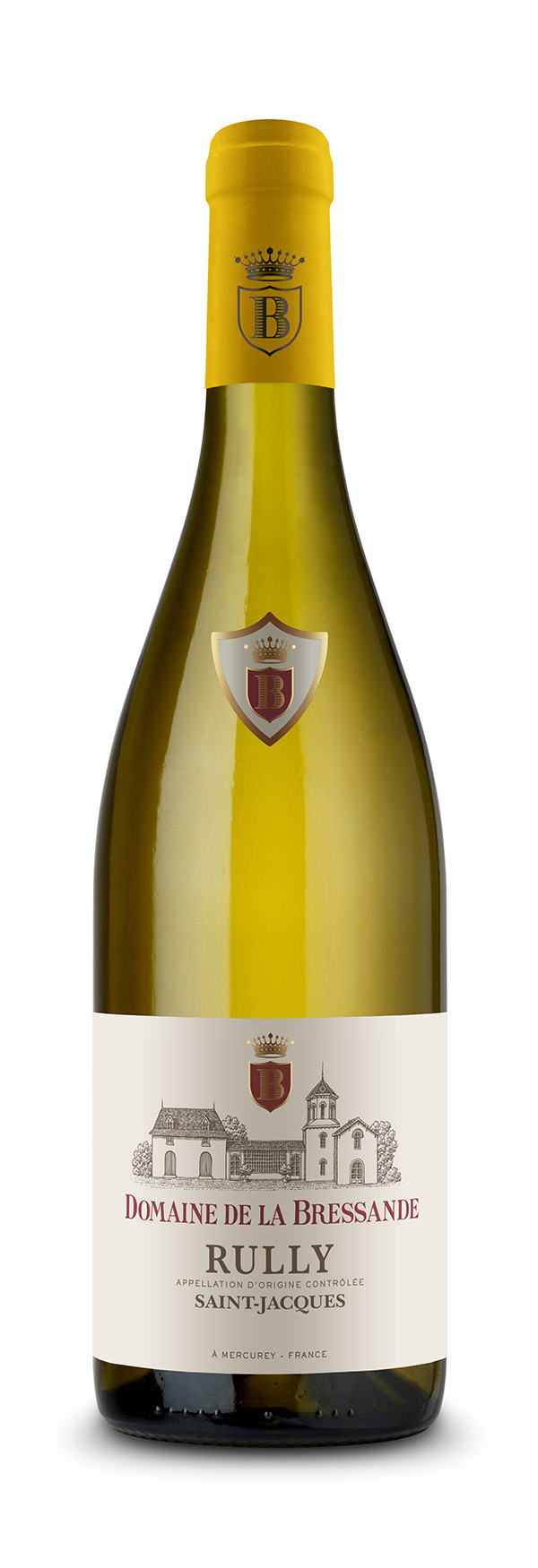
Colour: Bright golden yellow.
Nose: Aromas of white and yellow fruits such as pear and pineapple, interwoven with delicate oaky notes.
Palate: A full-bodied, generous wine, supported by a well-defined minerality.
Food and wine pairing
Very pleasant on its own, as an aperitif, it will also go well with white meats and fish in sauce. Also to be discovered with spicy cuisine or cheese.
Serving suggestions
Serve ideally at around 14° C. (57°F).
Ageing potential
It will easily age for 5 years in the cellar, in good conditions.
Origin
The Rully appellation is a village appellation with 23 climats classified as Premiers Crus (i.e. 30% of the vineyard area). 246 ha are devoted to white wines (including 69 ha of Premiers Crus) and 121 ha to reds (28 ha of Premiers Crus).
Domaine de la Bressande stretches across the villages of Mercurey and Rully, with 9.20 hectares in Rully Village and Rully Premier Cru.
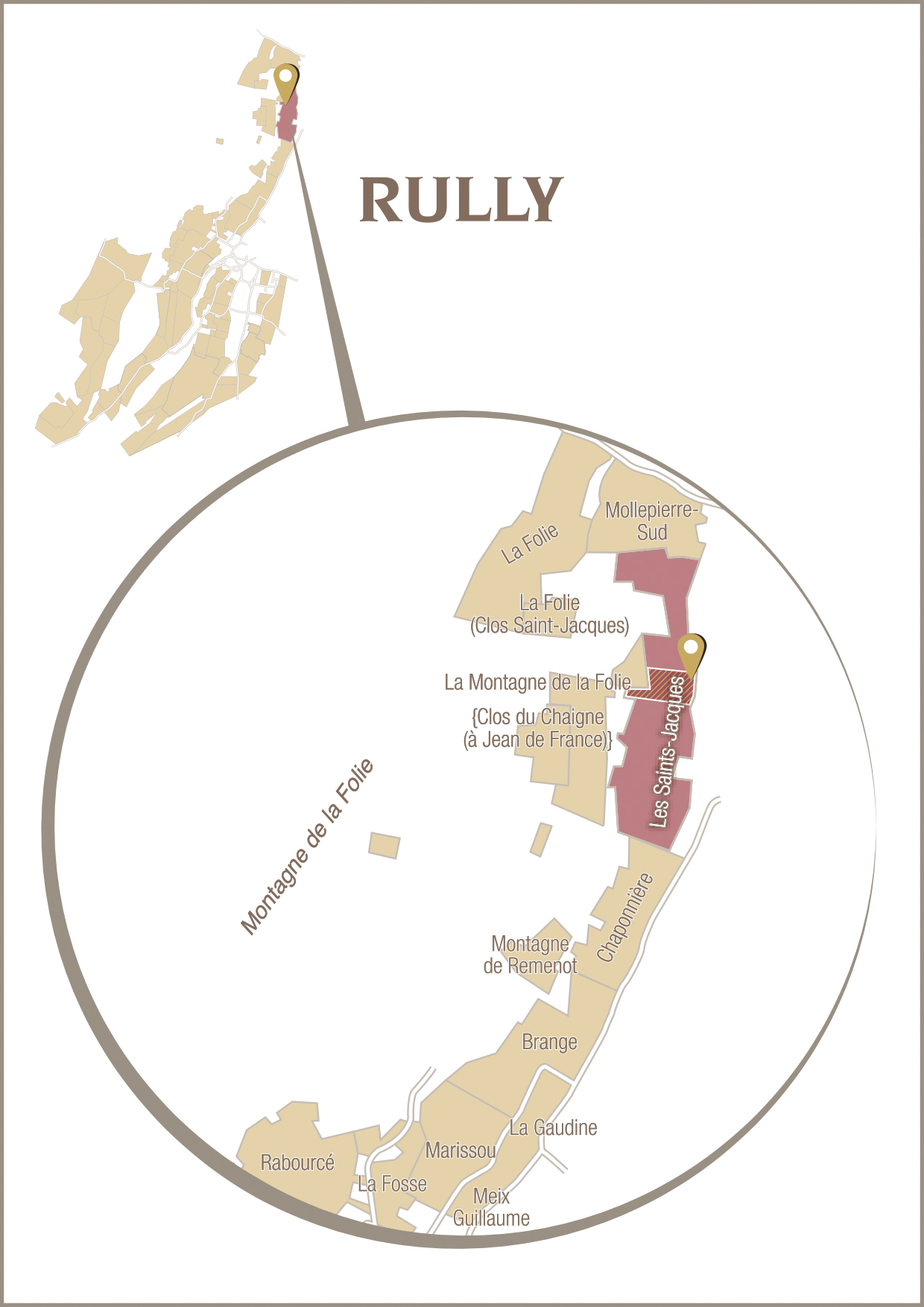
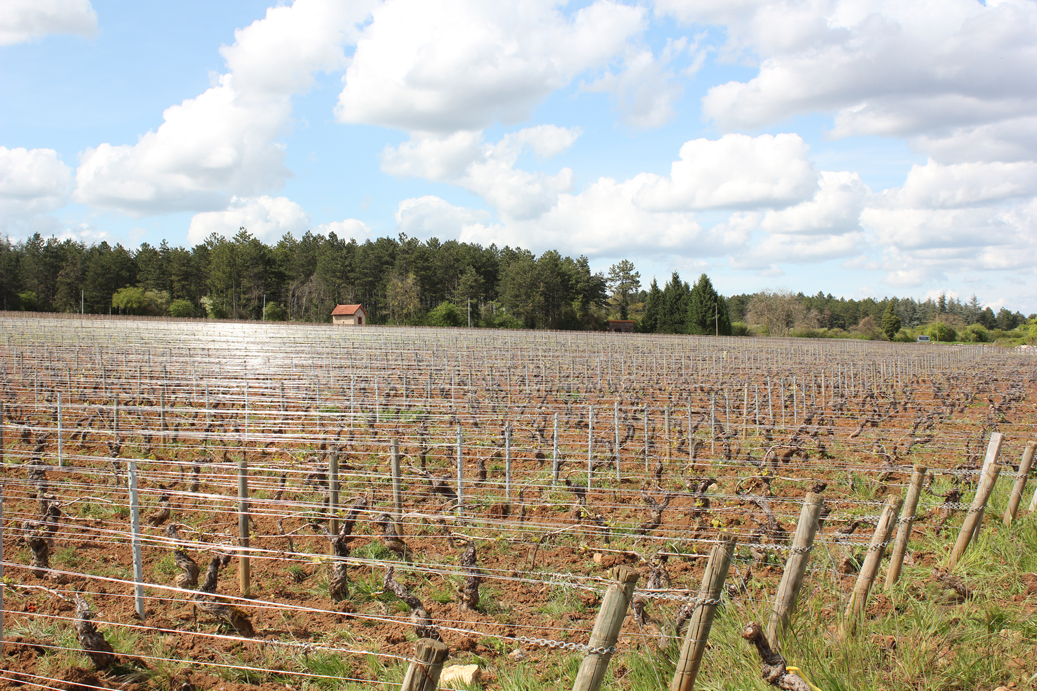
The “Saint-Jacques” parcel covers 1.5 hectares under the Rully Village appellation, and its name is thought to come from an old pilgrimage route used by those travelling to Compostela.
Terroir
- Vineyard area: 1,5 ha
- Vines age: 30 years
- Soil: Silty-calcereous
Vinification and maturing
Harvested on September 16th, the grapes for our Rully Blanc “Saint-Jacques” were directly pressed upon arrival at the winery, then cold settled for 16 to 24 hours to eliminate the coarse lees (solid particles from skins, stems, pulp and impurities that settle by sedimentation).
Alcoholic fermentation was carried out in temperature-controlled stainless-steel tanks to ensure precise temperature management and a homogeneous cuvée before being transferred into barrels at the end of fermentation. The wine was then aged in these barrels (25% new oak) on fine lees for 9 months, with occasional bâtonnage (around twice a month) until malolactic fermentation, in order to develop complex aromas while preserving pure fruit expression, and to protect the wine both from oxidation (in contact with the barrel and bung hole) and from reduction (build-up of sometimes sulphurous deposits).
Vintage : 2019
Winter was mild across our vineyards in the Côte Chalonnaise.
Budbreak took place at the beginning of April.
The frost episode on April 5th caused damage in several plots. The second frost (April 13th–14th) had less impact, as the villages of Rully and Mercurey were better prepared and smoke screens were used in the most frost-prone areas. Bunch emergence occurred around April 20th.
Spring remained slightly wet but mostly cold throughout May and up to flowering, which took place around June 10th–15th. This weather particularly favoured “coulure” (flower loss). Vegetative growth was very slow during the whole spring.
Summer was hot and dry, with heatwave conditions, leading to significant “millerandage” (shot berries). Harvest took place from September 9th to 24th under radiant sunshine, with excellent ripeness levels and superb overall balance.
Across the whole estate, yields are estimated to be down by around 30%, with some plots much more affected than others.
Awards
Tastevinage d'Automne - Tasteviné - October 2023
GUIDE HACHETTE - 1 Etoile - January 2022
CONCOURS DES BURGONDIA - Silver Medal - February 2021
CONCOURS DES GRANDS VINS DE France - MACON - Gold medal - January 2021
INTERNATIONAL WINE CHALLENGE - Gold medal - January 2021